1. Who I Am
I’m an independent electronics engineer based in Shenzhen, China—the engineer behind IC88. You can simply call me Mr. Peng.
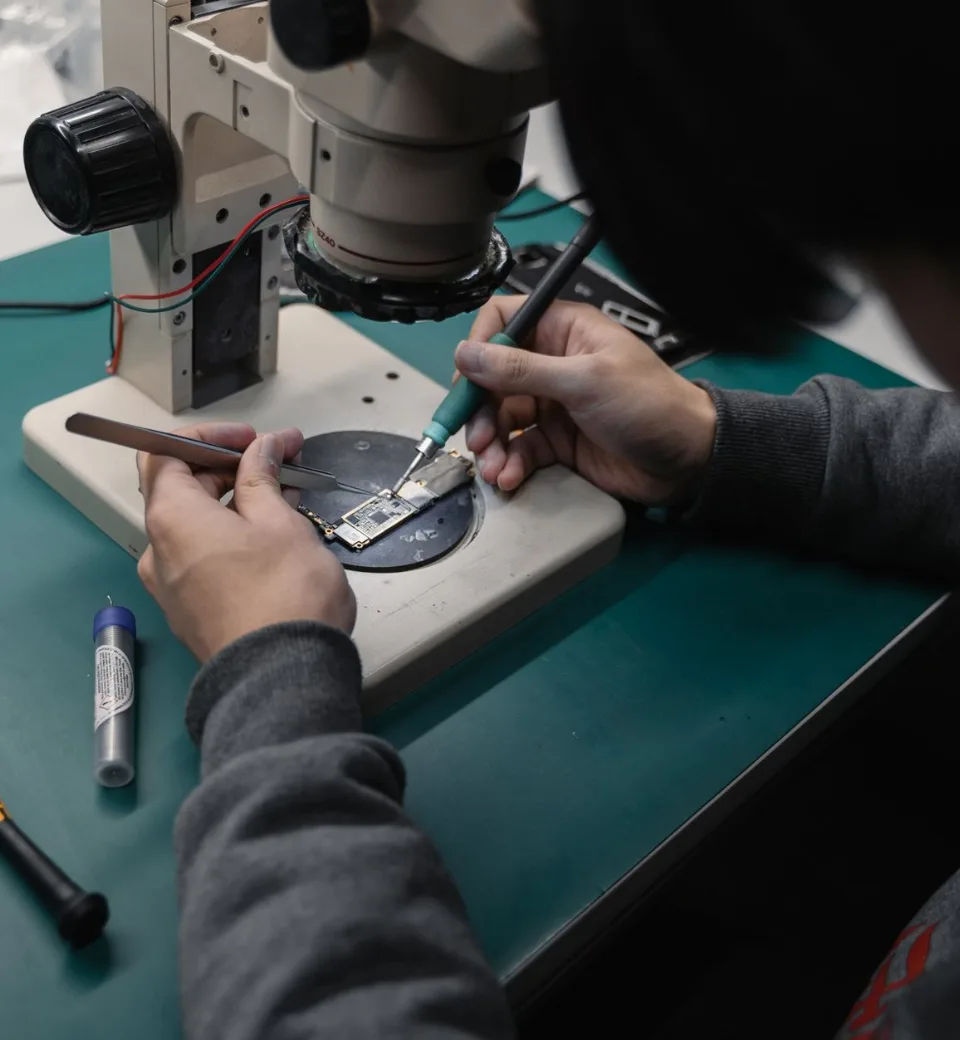
Today, I run IC88 independently alongside my family as our own small, hands-on hardware studio. IC88 isn’t a sprawling contract factory, an online component mall, or a sales-driven outsourcing agency. It is a quiet engineering workshop built around a real test bench: oscilloscopes, DC power supplies, soldering and hot-air rework stations, programmer probes, and trays of microcontrollers and passives. When you write to IC88, you aren’t routed to a sales rep or account manager—you talk directly with me (the engineer reading your notes, drawing the schematic, and probing the prototype board) or my wife, who works alongside me and knows Shenzhen’s local IC market and component retailers inside out.
2. 20+ Years with Microcontrollers — From Design to Production
For more than twenty years, my day-to-day craft has centered on microcontroller (MCU) hardware and embedded firmware. Earlier in my career, I spent nearly ten years at one of China’s leading automotive diagnostic tool companies, focusing primarily on OBD (On-Board Diagnostics) and automotive electronics development.
Automotive diagnostic hardware is a demanding proving ground: boards must survive harsh vehicle power transients, communicate reliably across multi-protocol automotive buses, and move smoothly from early bench samples into volume manufacturing. That decade gave me end-to-end familiarity with the entire microcontroller lifecycle—from schematic design, PCB layout, and embedded firmware all the way through component engineering, DFM, SMT assembly, and production testing.
Over two decades of designing, laying out, and debugging boards, you learn quickly that getting a circuit to compile in CAD is the easy half. The real lessons happen on the bench:
- Why a board works fine from a lab supply at 25°C, then brown-outs the instant a relay, motor, or wireless burst draws peak current.
- How a single overlooked boot-mode pin, missing pull-up, or shared interrupt line can stall firmware bring-up for days.
- Where ground return currents actually flow on a 2-layer vs. 4-layer PCB—and how layout choices decide whether analog readings stay rock-solid or drift with noise.
- How to choose straightforward, durable components that remain easy to buy instead of painting a design into a single-source corner.
That accumulated intuition—knowing what tends to break before ordering boards, and knowing where to put the scope probe when something acts up—is what I bring to every small project.
3. Why Shenzhen & Trusted Local Supply-Chain Partners
Working in Shenzhen means sitting inside the most responsive hardware ecosystem in the world. Bare PCBs, solder stencils, connectors, sensors, passive kits, and specialized ICs that take weeks to gather elsewhere can often reach my bench in days or hours.
Just as importantly, after twenty-plus years in Shenzhen’s electronics industry, I maintain close, long-standing relationships with many trusted local IC vendors, component suppliers, PCB fabricators, and SMT assembly factories. For independent creators and small runs, those relationships make a real difference: sourcing genuine parts reliably, getting single-piece or small-batch SMT boards assembled with care, inspecting solder joints under a microscope, and verifying on my own bench that every prototype genuinely powers up and runs before shipping overseas.
4. Why My Family and I Started IC88
Large electronics manufacturers and design houses are set up for big corporate budgets and high-volume purchase orders. If you are an independent creator, a researcher, an artist, a solo founder, or someone building your very first piece of custom hardware, you often hit an uncomfortable gap: factories ask for complete production Gerbers and big MOQs, while online forums can only take you so far.
Starting IC88 independently with my family allowed me to focus on filling that gap on a human scale—a place where one person with a thoughtful idea, even for a single working prototype, can get calm, honest, experienced engineering help. As an independent family-run venture, every inquiry, project collaboration, and word of encouragement means a great deal to us—thank you sincerely for your trust and support.
5. Hardware Creation in the Age of AI
AI makes hardware creation accessible. I help make it real.
Today, anyone can sit down with an AI assistant to brainstorm a device concept, generate an Arduino or ESP32 sketch, or draft a preliminary parts list in a weekend. Rather than replacing hardware engineering, AI has unlocked curiosity for thousands of people who previously felt locked out by schematics and datasheets.
At the same time, electricity doesn’t negotiate with a language model. Reversed regulator pins, under-rated MOSFETs, missing flyback diodes, or noisy switching loops still release magic smoke on real copper. My favorite collaborations today start right where AI leaves off: taking your rough concept, AI-generated circuit, or breadboard experiment, reviewing it with twenty years of practical judgment, and turning it into dependable hardware that works on a real desk.
6. How I Work with People in the Philippines
Many of the people I help live in the Philippines. Clear, unhurried written communication makes distance straightforward:
- Plain English first: You never have to apologize for not knowing electronics terminology. Describe what you want the device to do and how people will use it.
- Step-by-step clarity: We check technical feasibility first, then agree on clear scope, deliverables, cost, and timing before starting engineering work.
- Visible bench progress: As work moves forward, I share schematic views, PCB previews, and real workbench updates from Shenzhen (
UTC+8) so you are never left guessing. - Honest boundaries: If an idea is simpler solved with an off-the-shelf module—or isn’t practical within your constraints—I will tell you openly at the start.